
At the Edge of Detection: Our Journey into Ultrashort Chain PFAS Analysis

February 18, 2026

When FREDsense launched its laboratory services in 2024, the goal was clear: provide PFAS data that customers could trust and use. Adoption grew steadily month over month as manufacturers and technology developers relied on our lab to support real-world decision-making.

Initially, analytical requests focused on the regulatory “gold standards.” The FREDsense journey progressed through these established methodologies:

  • EPA 533 & 537.1: FREDsense established these drinking water methods, targeting legacy long-chain compounds and short-chain ethers.
  • EPA 1633 (Aqueous): Capability was then expanded into non-potable waters, utilizing the 40-compound list for robust wastewater and groundwater monitoring.
  • EPA 1633 (Solids): FREDsense further extended its scope into complex matrices, applying rigorous extraction techniques for soils, sediments, and biosolids.
  • Direct Injection (DI): To streamline high-throughput needs, FREDsense developed Direct Injection capabilities, achieving ppt-level (parts per trillion) sensitivity for rapid aqueous analysis.
  • TOP Assay: To reveal the “hidden” PFAS inventory, FREDsense implemented the Total Oxidizable Precursor assay, uncovering precursors that standard methods cannot detect.

But by mid-2025, customer conversations began to change. A new question surfaced repeatedly:

“Can you measure ultrashort chain PFAS?”

At first, these requests came from customers working on advanced PFAS capture and destruction technologies. They were seeing PFAS mass that didn’t disappear after treatment — it simply shifted. Increasingly, ultrashort chain PFAS were showing up in treated effluents, even when longer-chain compounds had been removed.

That customer pull marked the beginning of FREDsense’s journey into one of the most analytically challenging areas of PFAS science.

Ultrashort Chain PFAS: Small Molecules, Big Challenges

Ultrashort chain PFAS are typically defined as compounds with three or fewer carbons (C1–C3), including trifluoroacetic acid (TFA) and perfluoropropanoic acid (PFPrA). Their extreme polarity and unmatched water solubility allow them to distribute broadly in aqueous systems. In some waters, they dominate total PFAS mass, particularly where precursor degradation or industrial emissions occur.
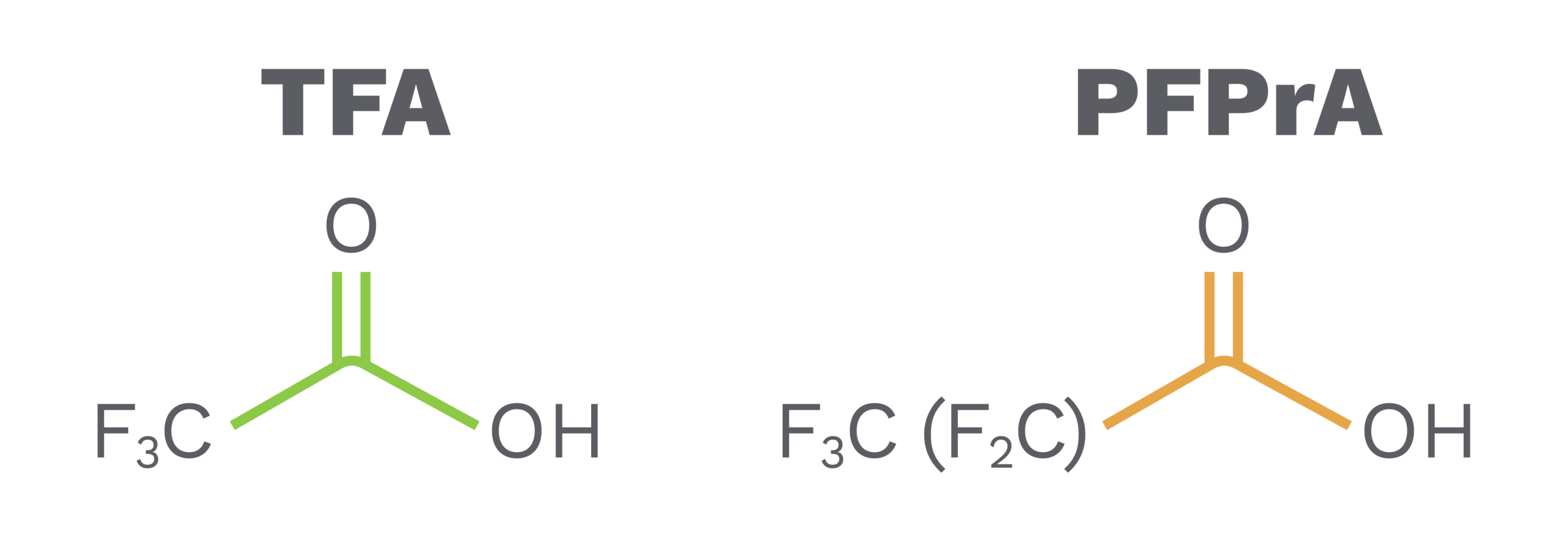
They are also frequently detected downstream of PFAS destruction technologies, where larger PFAS are transformed into smaller, more mobile molecules.

Despite their increasing prevalence, ultrashort-chain PFAS are notoriously difficult to quantify. Standard analytical protocols rely on Solid-Phase Extraction (SPE) followed by LC-MS/MS—a combination highly effective for legacy long-chain compounds but one that fundamentally fails for ultrashorts.

Due to their minimal molecular size and extreme polarity, these Ultrashort chain PFAS exhibit a weaker affinity for traditional SPE sorbents. In practice, this means they often “break through” during sample cleanup or fail to be retained during concentration, passing through the system undetected. In contrast to longer-chain PFAS, which are readily retained and enriched, ultrashort PFAS are easily lost—especially at trace concentrations.

LC-MS/MS at the Limits

Beyond poor retention, ultrashort PFAS present several interrelated analytical challenges:

  • Limited confirmation ions: Many ultrashort PFAS produce only a single dominant fragment during MS/MS fragmentation. This lack of a secondary qualifier ion challenges structural confirmation and increases the risk of false positives during trace-level analysis.
  • Low recoveries: Conventional SPE workflows fail to effectively concentrate these analytes, compromising accuracy and precision during trace-level analysis.
  • Background contamination: Compounds such as TFA are common laboratory contaminants, present in solvents, reagents. Even with PFAS-free consumables and rigorous blanks, background signals can obscure true environmental concentrations.

These challenges explain why most regulatory PFAS methods — including EPA 533 and EPA 537.1 — were never optimized for ultrashort PFAS. Non-detection often reflects method limitations rather than absence in the environment.

ASTM D8628-25: Standardization with Trade-offs

To address the lack of formalized methods, ASTM International published ASTM D8628-25, a first standardized LC-MS/MS method for ultrashort chain PFAS in aqueous samples. The method represents an important step forward, providing consistency and defensibility for laboratories and data users.

ASTM D8628-25 is built around sample preparation approaches aligned with EPA 1633, including conventional SPE. This alignment supports reproducibility across labs, but it also means the method inherits known limitations. Detection and reporting limits are constrained by SPE recovery and background contamination, with concentrations below the lowest validated calibration level often reported as estimates.

For many applications, this level of sensitivity is appropriate. For others — particularly those evaluating PFAS destruction, transformation, or low-level residuals — it is not sufficient.

Responding to Customer Demand for Lower Limits

As requests for ultrashort PFAS analysis increased through 2025, a consistent message emerged from our customers: low limits of detection matter.

In response, FREDsense onboarded an enhanced analytical workflow designed specifically to extend sensitivity into the low ng/L (ppt) range. Rather than relying exclusively on SPE, this approach uses a direct injection (dilute-and-shoot) strategy, intentionally bypassing cleanup steps that are known to lose ultrashort analytes.

By pairing direct injection with a high-sensitivity mass spectrometry platform and rigorous internal standard protocols, we maximize signal response while preserving analyte mass. This method has proven particularly effective for compounds such as TFA, DFA, PFPrA, and 2,3,3,3-TeFPrA — species that often define PFAS profiles in treated waters.

The trade-off is well understood: direct injection demands strict control of background contamination and matrix effects. It is not a regulatory standard, and it is not suitable for every sample type. But for customers seeking actionable insight at very low concentrations, it delivers sensitivity that SPE-based methods often cannot.

Two Paths Forward

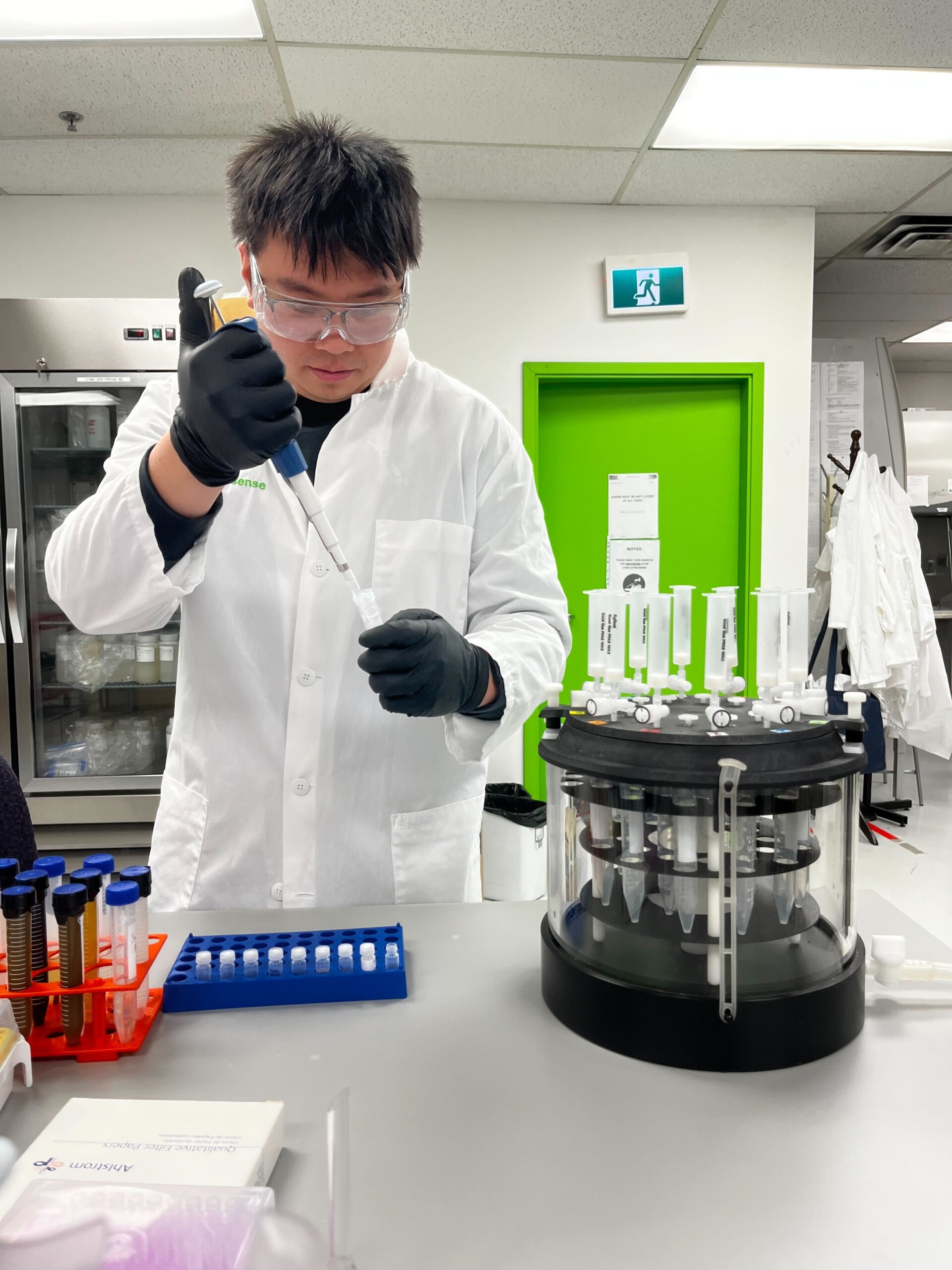
As ultrashort PFAS demand continues to expand across customer types, industries, and markets, FREDsense is preparing to launch ASTM D8628-25 alongside our enhanced low-LoD methodboth delivered with industry-leading turnaround times.
This reflects what we see in practice:

  • Some applications require standardized reporting.
  • Others require maximum sensitivity, even at the limits of current analytical techniques.

Rather than offering a single method, we focus on aligning our analytical approach with project goals — transparently and deliberately.

Precision at the Precipice

Ultrashort chain PFAS challenge conventional PFAS analytics not because they are rare, but because their chemistry defies long-standing assumptions. High polarity, poor retention, limited fragmentation, and pervasive background contamination push LC-MS/MS to its limits.

Yet these compounds increasingly define PFAS mass balances and regulatory conversations.

FREDsense’s journey into ultrashort PFAS began with customer questions, evolved through method development, and continues as standards catch up with science. In an era where ultrashort PFAS matter more than ever, precision at the lowest concentrations is no longer optional — it is essential.