
Introduction
This white paper outlines the scope and preliminary results of the collaborative work between FREDsense Technologies Corp. and Kurita Water Industries Ltd., focused on the application and validation of the innovative FRED-PFAS field testing kit. This partnership leverages FREDsense’s expertise in developing rapid, field-deployable environmental testing solutions and Kurita’s extensive knowledge in water treatment and industrial processes to address the growing need for efficient and accurate Per- and Polyfluoroalkyl Substances (PFAS) detection. The discussions and data presented herein are based on work completed in March 2025, the final phase of a multi-phase pilot program. Since then, the partnership has continued to strengthen as FRED-PFAS technology evolves and new advancements are released.
The Growing Need for Rapid PFAS Detection
PFAS are a class of thousands of synthetic chemicals that have been used in various industrial and consumer products since the 1940s. Due to their persistence in the environment and potential health risks, PFAS contamination has become a significant global concern. This concern is driving regulatory reforms, increasing public awareness, rising investments in water and wastewater treatment, and stricter environmental standards for PFAS emitters. Consequently, the PFAS analytical market is experiencing significant growth, with a projected Compound Annual Growth Rate (CAGR) of 14.5% between 2024 and 2030. This necessitates the development of efficient and cost-effective PFAS testing methods.
FREDsense Technology: A Novel Approach to PFAS Detection
FREDsense has developed FRED-PFAS, the world’s first field PFAS testing kit. Building on FREDsense’s history of developing field kits for contaminants like COVID and arsenic, FRED-PFAS offers a unique solution for rapid, on-site PFAS analysis.
The FRED-PFAS technology employs proprietary “binding systems” to detect the fluorocarbon backbones of PFAS molecules. It employs fluorescent detection methods, allowing for versatile product configurations. The system is designed as a Total PFAS screening measurement system, demonstrating the ability to detect <1000 ng/L – parts per trillion (ppt) of isolated PFAS compounds. The technology utilizes polymer-based binding systems that can be generalized or chemically customized to detect a surrogate for Total-PFAS or particular species.
The detection mechanism involves a polymer material with a fluorescent dye added. When a water sample containing PFAS is introduced, the PFAS interacts with the polymer and displaces the dye, resulting in a drop in the fluorescent signal. This fluorescence change is proportional to PFAS concentrations. The FRED-PFAS system demonstrates affinity for a wide range of PFAS, with best performance in chain lengths C5 and longer.
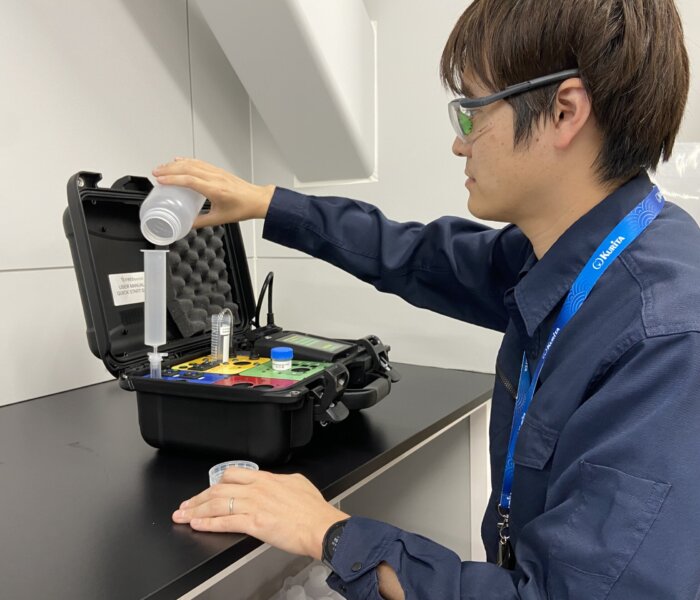
The FRED-PFAS product consists of the FRED-Capture + FRED-Fluor unit.
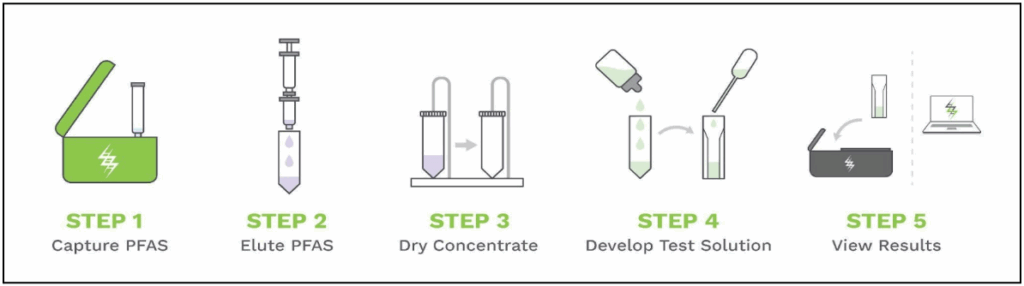
The testing process involves five steps: Capture PFAS, Elute PFAS, Dry the Sample, Develop Final Test Solution, and View Results via fluorometry (Figure 2). The ability to obtain same-day results provides significant time and cost savings for treatment operators and consultants.
Collaboration Scope and Objectives
The collaboration between FREDsense and Kurita aimed to validate the performance and applicability of the FRED-PFAS technology in various water matrices relevant to Kurita’s industrial clients. Key objectives included:
- Evaluating the accuracy and precision of FRED-PFAS in real-world samples.
- Assessing the robustness and ease of use of the field testing kit by Kurita staff.
- Exploring potential applications of FRED-PFAS in Kurita’s service offerings, such as monitoring and treatment optimization.
- Providing feedback to FREDsense for further product development and improvement.
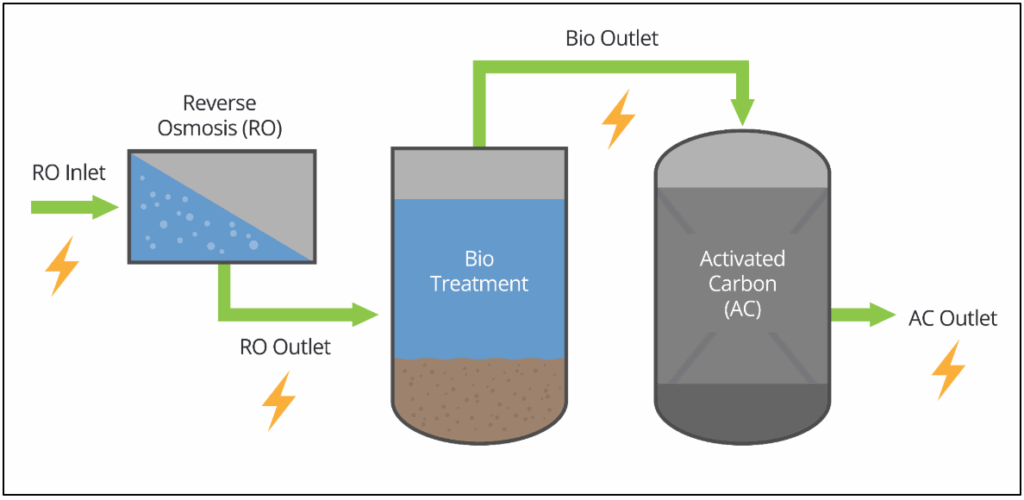
The project presented herein focused on industrial wastewater. Testing was conducted on various process stream sample points, including RO (Reverse Osmosis) Inlet and Outlet, Biological Treatment Outlet, and AC (Activated Carbon) Outlet, as depicted in Figure 3.
Testing was completed at two facilities: Industrial Wastewater Client Site (4 discrete sampling locations, 3 replicates each performed by Kurita operators) and Kurita Innovation Hub, KIH (3 discrete sampling locations, 5 replicates each performed by FREDsense staff at KIH). In addition, certain samples were spiked with 15 µg/L (ppb) of a PFOA:PFOS (50:50) mix to assess the system’s performance on a known amount of PFAS.
Success Criteria
In addition to assessing the robustness and ease of use of FRED-PFAS, accuracy and precision were evaluated. For this project, success as it relates to accuracy and precision were defined as follows:
- Accuracy: ±50% relative error (%RE) whereby accuracy refers to the degree of closeness between a measured value and the “true value”. In this context, the “true value” is defined as the chosen concentration of 50:50 PFOA:PFOS spike calculated as % relative error = (absolute error / “true value”) x 100.
- Precision: ±35% relative standard deviation (%RSD) for multiple repetitions.
Samples were compared with laboratory methods ISO 21675:2019 performed by Kurita and EPA 1633 performed by FREDsense and Total Organic Fluoride (TOF) by CIC performed by a third party laboratory.
Results
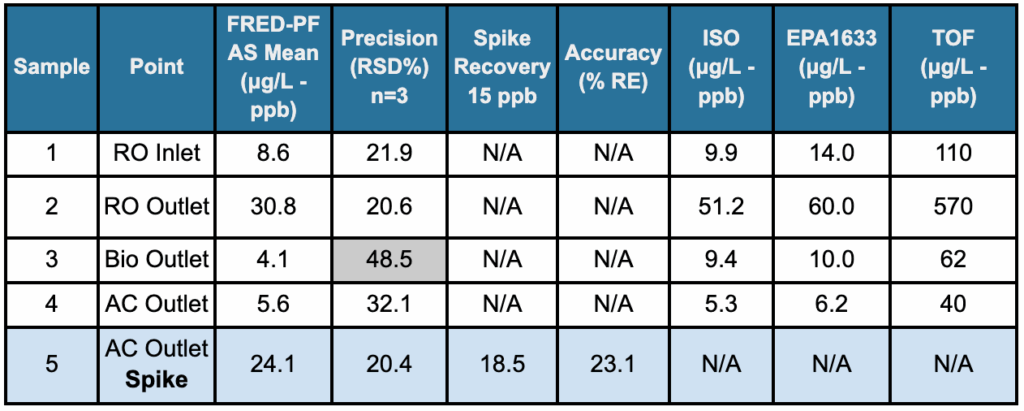
- Industrial Wastewater Site Results: Testing showed that precision metrics were met for all samples except sample 3 (Bio Outlet), which had higher standard deviation likely due to lower sample concentration. Spike recovery showed good results at the client site. Additional replicates confirmed an initial outlier in sample 2 (RO Outlet).
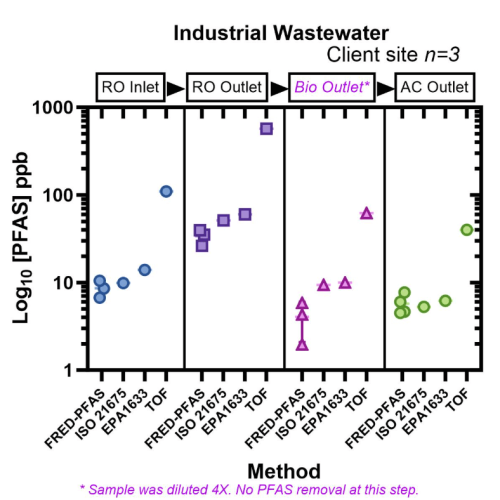
Table 1 – Summary of Industrial Wastewater Testing done at client site. N/A = not applicable.
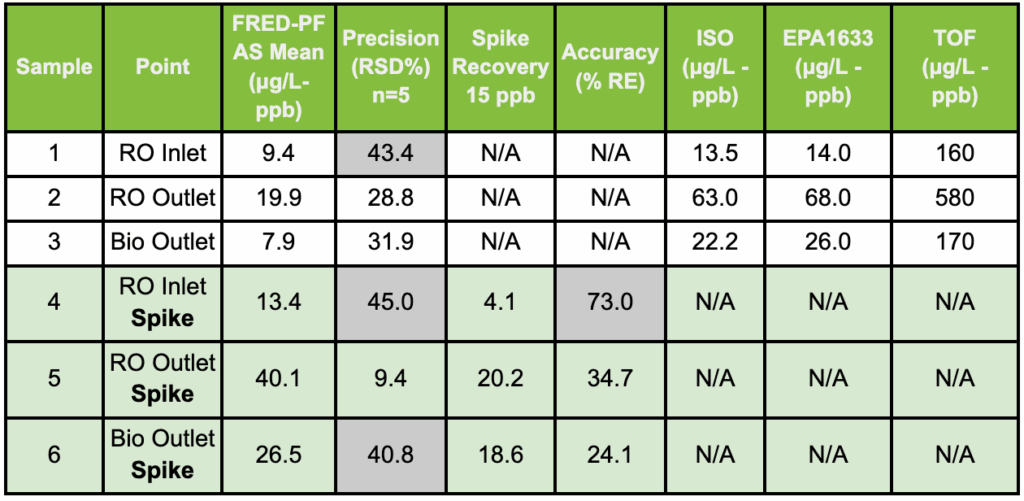
2. KIH (FREDsense) Results: Testing at KIH showed good recovery of spike in samples 2 and 3, but poor recovery in sample 1, which had high variability on both spiked and non-spiked samples. Accuracy met project goals for 2 out of the 3 spiked samples.
The results showed strong correlation between FRED-PFAS and laboratory methods ISO and EPA1633, with the exception of RO Outlet. This particular sample displayed a yellow color which may indicate the presence of some sensor inhibitors in the RO concentrate, such as organic matter or others.
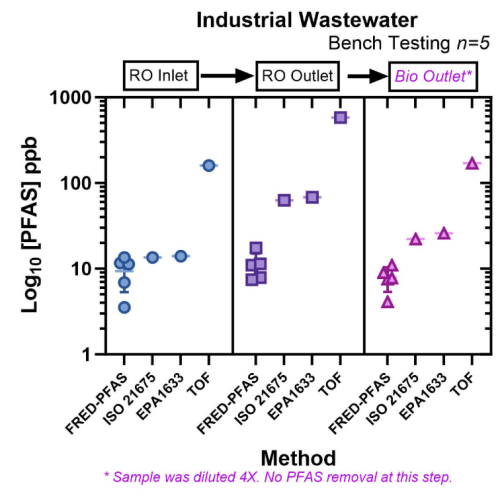
Table 2 – Summary of Industrial Wastewater Testing done at KIH. N/A = not applicable.
Conclusions
The project showed expected trends in PFAS levels using FRED-PFAS technology when compared with laboratory results. Precision success criteria were met for most sample points, showing high repeatability of FRED-PFAS measurement, with as low as 9.4% RSD in the best case and 48.5% RSD in the worst case. As for accuracy compared to a known PFOA:PFOS spike, FRED-PFAS met the success criteria outlined in the project for all but one sample, the RO inlet spike which had a lower spike recovery measurement than expected.
Regarding robustness and ease of use metrics, Kurita staff were able to successfully run 12 samples at their client facility without FREDsense technicians present. Importantly, very good feedback was received from the Kurita team regarding the use of the devices, including the need for lowering the limit of detection and mechanical design improvements such as reinforcing the plastic supports and altering the tubing design in the FRED-Capture device.
Future Improvements
The post-project discussions between both parties acknowledged potential sources of error and future improvements for FRED-PFAS design, including:
- Limitations on PFAS SPE (Solid Phase Extraction) process, where EPA 1633 has expected recovery between 50-150% depending on the analyte. Specifically, EPA1633 SPE has marginal/poor performance with ultra-short chain PFAS. Similarly, FRED-PFAS does not capture ultrashort chain analytes which are lost in the sample preparation process.
- Error from the fluorescent measurement, which is being addressed through repeated measurements to refine calculations and firmware programming of the FRED-Fluor device.
- Error from the fluorescent measurement interpolation, related to the fitting to the standard curve. This is being addressed by applying a new interpolation algorithm.
- Improving the Limit of Detection (LOD) and Limit of Quantification (LOQ) of the devices to enhance accuracy in the lower concentration range.
Potential Applications and Future Outlook
The FRED-PFAS technology, validated through collaboration with Kurita, holds significant potential for various applications, including:
- Environmental Monitoring: Rapid screening of water sources including groundwater near Aqueous Film-Forming Foam (AFFF) impacted sites.
- Industrial Wastewater Monitoring: On-site monitoring of PFAS levels in industrial discharge.
- Treatment Process Optimization: Real-time monitoring of PFAS removal efficiency in water treatment plants, enabling optimization of treatment processes.
- Source Tracking: Identifying potential sources of PFAS contamination through rapid screening of multiple locations.
The ongoing collaboration between FREDsense and Kurita signifies a commitment to advancing PFAS detection capabilities. By combining FREDsense’s innovative technology with Kurita’s industry expertise, this partnership is well positioned to accelerate innovative solutions for PFAS analysis and treatment optimization strategies using rapid PFAS screening technologies, like FRED-PFAS.
For further information, please contact:
Melanie McClare, P.Eng, MBA
+1-403-869-6799
melanie@fredsense.com
www.fredsense.com