
How to support transitioning from PFAS containing firefighting foams to alternative foams
In March 2026, the Finnish Environment Institute (SYKE) hosted an international webinar presenting results from a real-world pilot project designed to test the Arctic Council‘s AFFF Foam Transition Manual. The project involved decontaminating two AFFF-loaded fire trucks, treating the resulting PFAS-contaminated wastewater on-site, and evaluating multiple analytical methods, including FRED-PFAS field screening, against conventional laboratory analysis.
The findings offer a detailed, data-backed look at where field-based PFAS detection adds operational value, and where the limits of traditional testing become a liability.
Project Overview
The pilot was funded by the Finnish Ministry for Foreign Affairs and executed in collaboration with Engwater Oy (on-site water treatment), Farsol Oy (vehicle clean-out), and FREDsense (rapid PFAS detection). The project addressed two core questions:
- How to effectively clean AFFF out of fire suppression equipment
- Whether the resulting wastewater could be treated on-site rather than transported for high-temperature incineration, a logistically intensive and costly disposal route, particularly in Arctic regions.
Two fire trucks (one airport and one military truck) were drained and flushed through multiple rinse cycles using pressure washing, warm water soaks, and glycol based rinsing mixtures. Each cleaning phase generated a separate batch of wastewater, collected in IBC containers and treated sequentially through a three-stage filtration system: granular activated carbon (GAC), a proprietary resin, and ion exchange (IEX).
The diagram below illustrates where FRED-PFAS was used during the process.
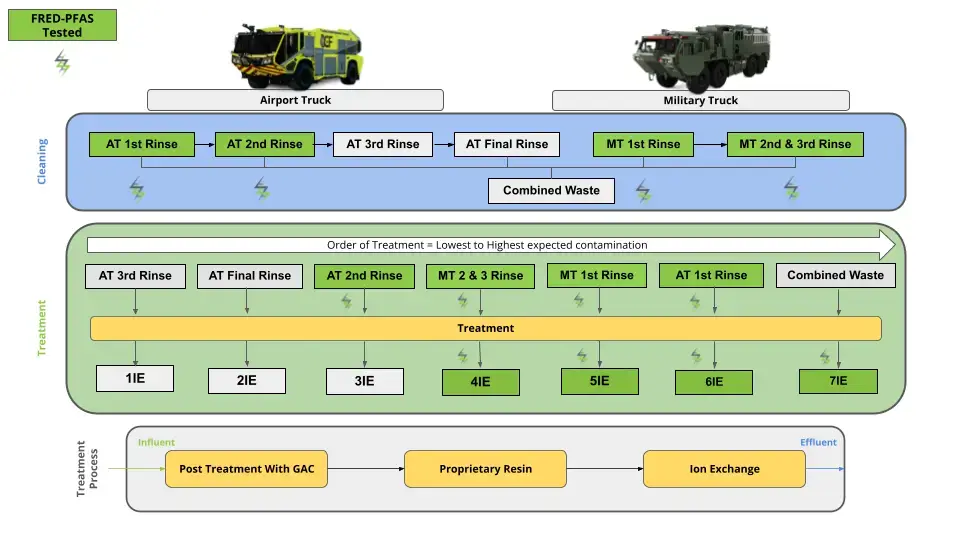
The three-stage treatment system achieved near-complete PFAS removal across most batches, with target PFAS reductions reaching 100% in five of seven effluent samples. For the two highest-concentration batches, the airport truck’s first and second rinses, reductions of 98.93% and 99.76% were achieved, though residual concentrations (16,000 ng/L and 63 ng/L, respectively) indicate the limits of the system under extreme influent loads.
Analytical Approach: Three Methods, Side-by-Side
Each wastewater batch was sampled for two types of laboratory analysis”
- Target PFAS (LC-MS/MS per DIN 38407-42 at Eurofins)
- Total Oxidizable Precursor Analysis (TOPA)
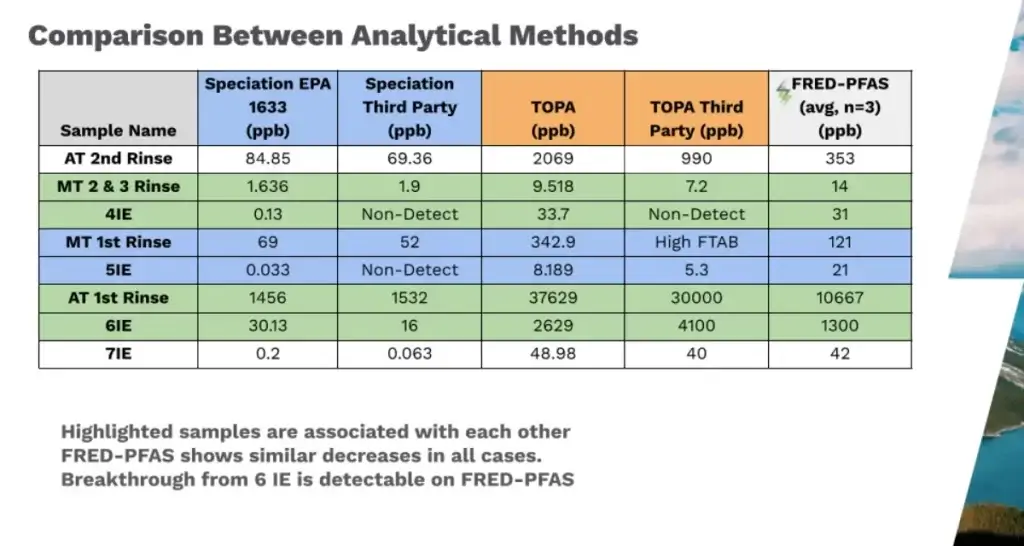
Eight parallel samples were submitted to FREDsense for on-site PFAS screening.
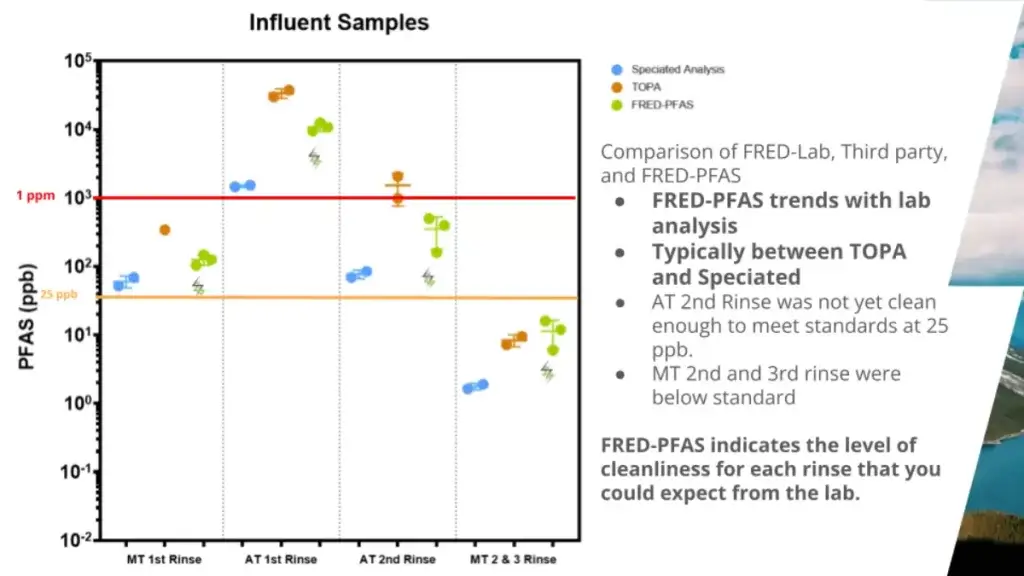
Influent concentrations varied significantly across batches, reflecting the cleaning history of each truck:
Pilot Learnings
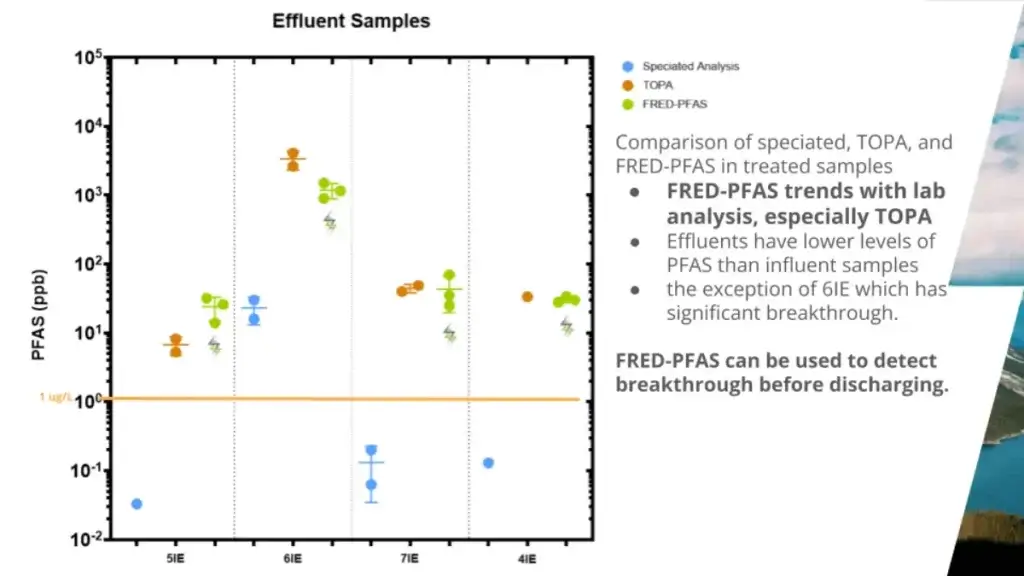
In one notable comparison, the TOPA method reported an effluent TOP PFAS sum of 5,300 ng/L, while FRED-PFAS detected 21,000 ng/L in the same sample. Standard target analysis reported non-detect for the same effluent. This divergence points to the presence of anionic PFAS precursors, compounds that FRED-PFAS is designed to detect broadly, that fall outside both the target analyte list and, in this case, the TOPA package selected for the project.
This is consistent with a broader finding from the project: TOPA analysis revealed unknown PFOA precursors in both rinsing water and surface swipe samples that target analysis missed entirely. The project’s lead scientist, Timo Seppälä of SYKE, raised the question directly in the concluding remarks: can rapid screening methods serve as a practical alternative or complement to TOPA, TOF, and AOF analysis?
The data from this project suggests FRED-PFAS occupies a useful position in the analytical hierarchy. It detects a broader signal than target analysis, and does so in hours rather than the six-to-seven week turnaround documented for laboratory samples in this project.
One challenge FRED-PFAS came up against was the dilution requirements in high PFAS concentration samples. FRED-PFAS is an innovative project, and with that comes the opportunity to test applicability in different samples. This project pushed FRED-PFAS and found a limit. Insights like these are taken back to our technology team in the spirit of continuous improvement.
Operational Value: Decisions That Can't Wait for Lab Results
The on-site treatment team processed wastewater batches in real time, without access to laboratory analysis results. Treatment decisions were made based on expected contamination levels and, where available, FRED-PFAS screening data.
FRED-PFAS showed a breakthrough in the treatment train during treatment batch 6. The 6IE shows that FRED-PFAS was able to detect when the treatment beds were saturated and new material should be substituted in.
For the Arctic context specifically, where transport distances to incineration facilities are significant and operational windows are limited, the ability to make data-informed decisions at the point of work is not incidental to the project. It is a project requirement.
Regulatory Context
The transition from AFFF to fluorine-free firefighting foams carries specific regulatory obligations in the EU. POPs Regulation 2019/1021 and REACH Regulation 1907/2006 require cleaning to be performed using the best available technologies, and ECHA has published guidance elaborating what that means in practice – including PFAS concentration limits that must be met to prevent rebound in cleaned systems.
Meeting those requirements demands chemical analysis. The question this project helps to clarify is which analysis, deployed in what sequence. Target analysis alone was identified as insufficient in this project, particularly when the PFAS foam history of a system is unknown. Field screening provides an early signal that can inform what confirmatory analysis is needed and when compressing the decision timeline without replacing the documentation that regulatory compliance requires.
Summary
For environmental consultants, remediation contractors, and operators managing AFFF transitions, the data from this project makes a clear case for integrating field-based PFAS screening as a standard component of the analytical workflow — not as a replacement for laboratory confirmation, but as the tool that makes the work between sample submission and result receipt productive rather than stalled.
Learn more about FRED-PFAS field screening or request a consultation: fredsense.com/contact-us
FREDsense Technologies Corp. participated as a technical partner in the Arctic Council ACAP AFFF Phase Out project. Data presented in this post is drawn from the “Testing the Arctic Council Transition Manual” webinar delivered March 26, 2026, with presentations by the Finnish Environment Institute (SYKE), Engwater Oy, and FREDsense Technologies.