
Key Takeaways:
- Latent reactions to guidelines can have an impact on your business long term. Treat guidelines as early warnings, not optional signals.
- Make proactive decisions using PFAS regulatory dashboards to give you real-time visibility into pending PFAS regulations so you can stay compliant, mitigate legal and reputational risk.
- Risk management now depends on anticipating uncertainty, not just meeting current rules.
PFAS has rapidly transitioned from a niche environmental concern to a defining global regulatory challenge. Companies are finding themselves in a race against regulatory momentum. Europe has emerged as the epicenter of policy innovation—setting the tone for how industries, regulators, and solution providers approach PFAS risk in the coming decade.
PFAS regulatory history has worked in every jurisdiction that has tackled it. Guidelines published today become enforceable limits within three to five years. Companies that waited for regulations to catch up to guidelines have consistently faced abrupt remediation timelines, unexpected liability, and costs that dwarf what early action would have required.
PFAS regulations are accelerating globally. Understanding the difference between what is currently required and what is coming is now a core business risk question, not just an environmental compliance one.
Regulations vs. guidelines: what the difference actually costs you
A regulation carries legal force. A guideline does not, but that distinction is temporary.
An evolving global regulatory landscape
Across North America, Europe, and parts of Asia, PFAS regulation is moving toward broader restrictions and class-based approaches rather than compound-by-compound regulation. This shift reflects the sheer scale of the PFAS universe—thousands of chemicals with varying properties but similar persistence.
Globally, we are seeing three key trends:
- Movement toward class-based restrictions rather than individual compound bans
- Increased liability and “polluter pays” frameworks
- Growing emphasis on monitoring, reporting, and remediation obligations
Europe, however, is going further—and faster—than most jurisdictions.
Europe: The Cost of Addressing Regulations
The European Union is further along this regulatory trajectory. The EU is actively advancing one of the most comprehensive PFAS regulatory frameworks in the world. Recent actions include bans on well-known compounds such as PFOS, PFOA, and PFHxS, alongside newer restrictions targeting PFHxA and related substances in consumer products.
The REACH universal PFAS restriction is expected to conclude scientific evaluation in 2026, and draft restriction proposals already cover thousands of compounds, not just the well-known ones like PFOA, PFOS, and PFHxS. The projected cost of addressing PFAS contamination across Europe is estimated at up to €1.5 trillion.
These PFAS restrictions are acutely impacting companies using firefighting foams. The EU has introduced phased restrictions on PFAS in firefighting foams, a historically significant source of environmental contamination. These restrictions include transitional timelines that recognize operational realities while signaling a clear long-term direction: widespread elimination.
What class-based regulation changes for your operations
Regulators in the EU, and increasingly in Canada and the U.S., are moving toward class-based restrictions. This means the entire PFAS group, thousands of per- and polyfluoroalkyl substances, is treated as a single regulatory concern rather than a list of individual compounds to manage sequentially.
For your operations, this has two direct consequences:
- First, substituting one PFAS for another to avoid a specific restriction is no longer a viable long-term strategy. Regulators have closed that door explicitly.
- Second, your monitoring program needs to detect beyond the short list of regulated compounds. If you are only testing for PFOA and PFOS, you are not getting an accurate picture of your actual PFAS exposure, and that gap will become a compliance gap when the next restriction cycle hits.
The unresolved regulatory challenge: PFAS rebound
There is a technical risk in PFAS remediation that most compliance programs underestimate: rebound.
Rebound refers to the phenomenon where PFAS concentrations decrease following treatment, only to rise again over time due to desorption from soils, back-diffusion from low-permeability zones, or ongoing source inputs. Although not yet fully understood across all matrices and treatment technologies, it has been consistently observed in field applications, creating uncertainty around long-term remediation performance.
This uncertainty has two major implications:
- Short-term treatment success may not reflect long-term outcomes
- Monitoring strategies must extend well beyond initial remediation phases
As a result, rebound is increasingly being recognized as a risk factor in remediation planning, even if it is not yet fully codified in regulation.
How risk tolerance drives decisions
In this evolving landscape, technical feasibility is only part of the equation. Risk tolerance across regulators, asset owners, and communities, is becoming a central factor in decision-making.
Some stakeholders may pursue aggressive remediation aligned with future regulatory thresholds, accepting higher upfront costs to reduce long-term liability. Others may adopt a phased approach, balancing current compliance with evolving science and regulation.
This is particularly relevant given the uncertainties around:
- Future regulatory limits
- Cumulative and mixture effects of PFAS exposure
- Long-term remediation performance (including rebound)
Ultimately, PFAS management is no longer a purely technical challenge. Now it is a strategic risk management exercise.
What good risk management looks like right now
As regulation accelerates, guidance is beginning to catch up—helping stakeholders move from reactive compliance to proactive strategy.
Organizations such as the OECD and EU bodies are working to standardize PFAS definitions and reporting frameworks, a critical step given the complexity of the chemical class. Meanwhile, practical guidance—such as transition frameworks for fluorine-free firefighting foams—is helping operators navigate real-world implementation challenges.
The key shift is this: regulation is no longer just about restriction; it is about decision-making under uncertainty. Companies are being asked to:
- Inventory PFAS use and exposure pathways
- Evaluate alternatives and transition timelines
- Develop remediation and monitoring strategies that align with future—not just current—rules
This is where tools like Antea Group’s PFAS Regulatory Dashboard are becoming essential. By translating complex, fast-moving regulatory developments into actionable insights, such platforms enable organizations to anticipate change rather than react to it.
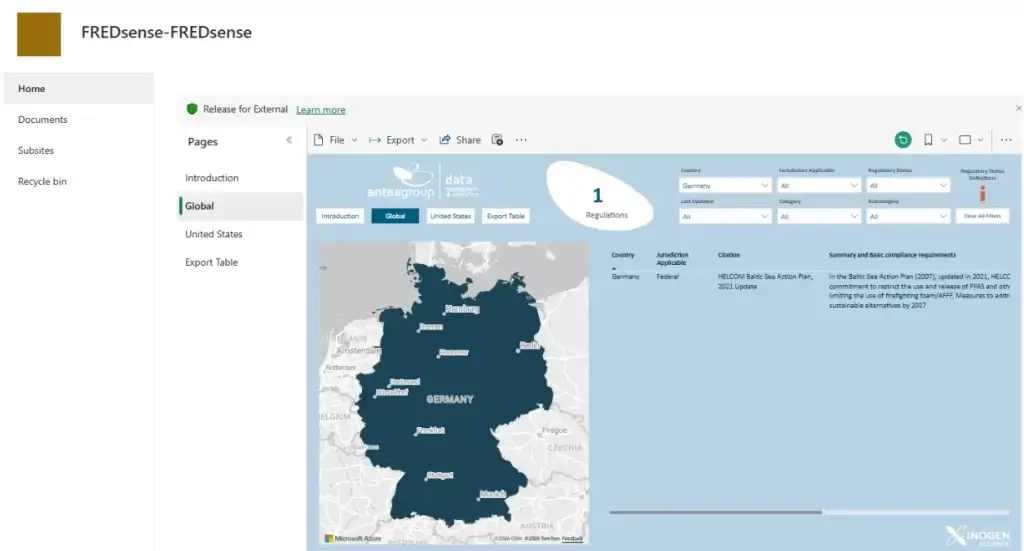
How to manage PFAS regulations in your business
In this regulatory context, access to timely, high-quality data is critical. Traditional laboratory testing, while highly accurate, can introduce delays that limit decision agility. Rapid analytical approaches enable:
- Real-time screening and adaptive sampling strategies
- Faster identification of contamination hotspots
- Improved monitoring of treatment performance—and potential rebound
This is where solutions like FREDsense’s rapid PFAS analytical services and field-deployable tools are transforming the market. When paired with regulatory intelligence platforms like Antea Group’s dashboard, these tools create a powerful combination: clarity on what is required, and speed in understanding what is happening on the ground.
Looking ahead
PFAS regulation is entering a new phase defined not just by restriction, but by integration. Policy, science, and technology are converging to shape how organizations assess risk, prioritize action, and future-proof their operations.
Europe is leading this transformation, but the implications are global. For stakeholders across industries, the path forward will depend on three capabilities:
- Regulatory foresight
- Data-driven decision-making
- Adaptive risk management
Those who invest early in these capabilities will be best positioned, not just to comply, but to lead, in the emerging PFAS landscape.