
A practical PFAS testing guide for water technology companies, membrane manufacturers, and solution providers operating in Singapore
PFAS regulations in Singapore are tightening. The Public Utilities Board (PUB) has adopted limits aligned with WHO 2022 drinking water guidance, the National Environment Agency (NEA) is expanding industrial discharge monitoring requirements, and the EU’s PFAS restrictions under REACH are creating upstream pressure on any company in a global supply chain. For membrane manufacturers and water technology solution providers in Singapore, this creates a huge opportunity to enter a new market, but it is paired with an immediate problem: clients are asking for PFAS data, and getting that data quickly is harder than it should be.
This guide outlines the three main options available for PFAS testing, with specific attention to what each option costs in time, money, and regulatory defensibility. There is no single right answer. The correct choice depends on why you need the data and what you plan to do with it.
Why PFAS testing matters specifically for membrane manufacturers and solution providers
If you manufacture membranes or deliver water treatment systems, PFAS testing is not just a compliance exercise. It is a core part of how you prove your product works.
Membrane manufacturers need PFAS data to:
- Validate rejection efficiency: your membrane claims only hold up if you can quantify what the membrane removes from a PFAS-contaminated feed stream
- Support product development: testing raw materials, process water, and finished product helps identify where PFAS enters or exits your manufacturing process
- Meet customer qualification requirements: increasingly, buyers require third-party PFAS test data before approving a membrane for their application
- Substantiate marketing claims: ‘PFAS removal’ without quantitative LC-MS data is not a claim that will survive regulatory or commercial scrutiny
Solution providers need PFAS data to:
- Establish pre-treatment baselines before system installation
- Demonstrate post-treatment efficacy to clients and regulators
- Support project reporting requirements tied to NEA discharge permits
- Respond to client requests for updated PFAS panels as the compound list expands
Water treatment and membrane manufacturers should all be looking at the compound list when selecting their PFAS testing provider. Most PFAS treatment projects require EPA 1633, Total Oxidizable Precursaor Assay (TOPA), and ultrashorts analysis given the growing interest in PFAS separation and treatment in Singapore.
Which PFAS compounds should you be testing for?
Before choosing a lab, clarify which compound classes are relevant to your use case. Below outlines the PFAS compounds to test for:
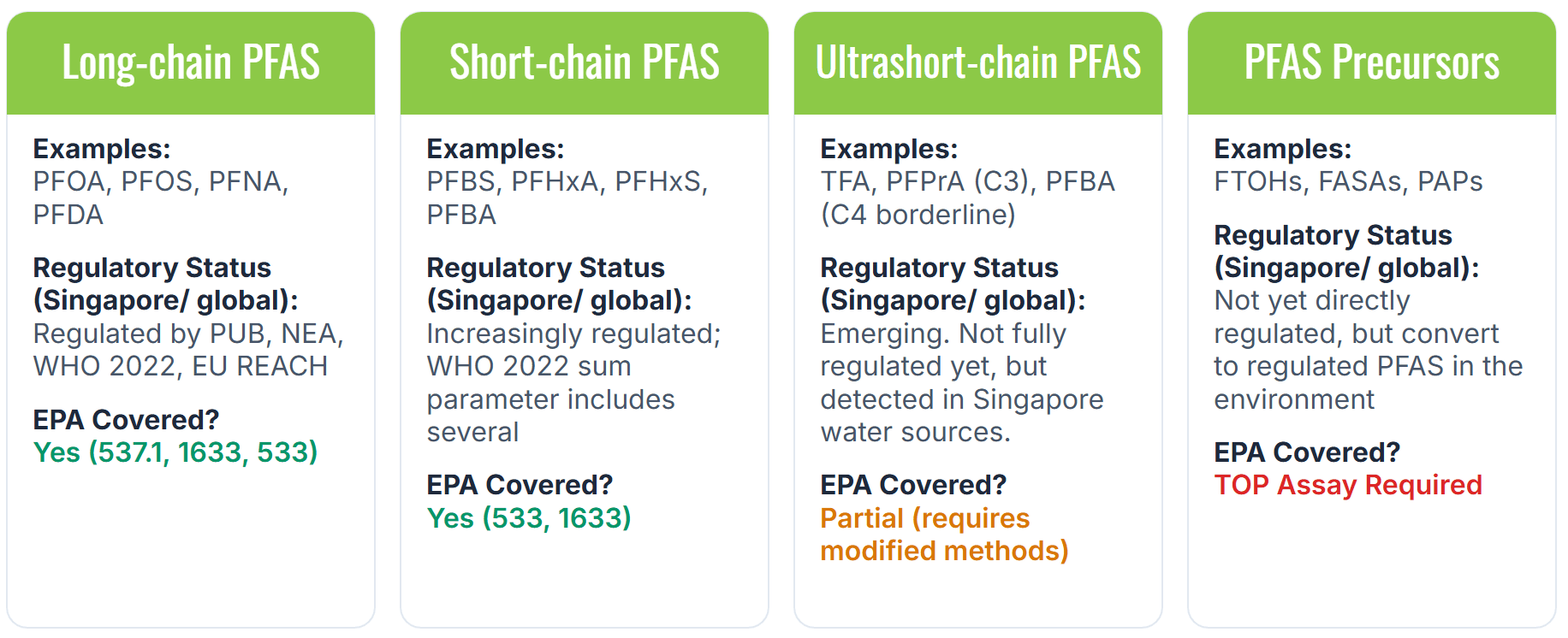
Now that you have your PFAS compounds, you can determine which PFAS lab can actually serve you.
Option 1: European accredited laboratories
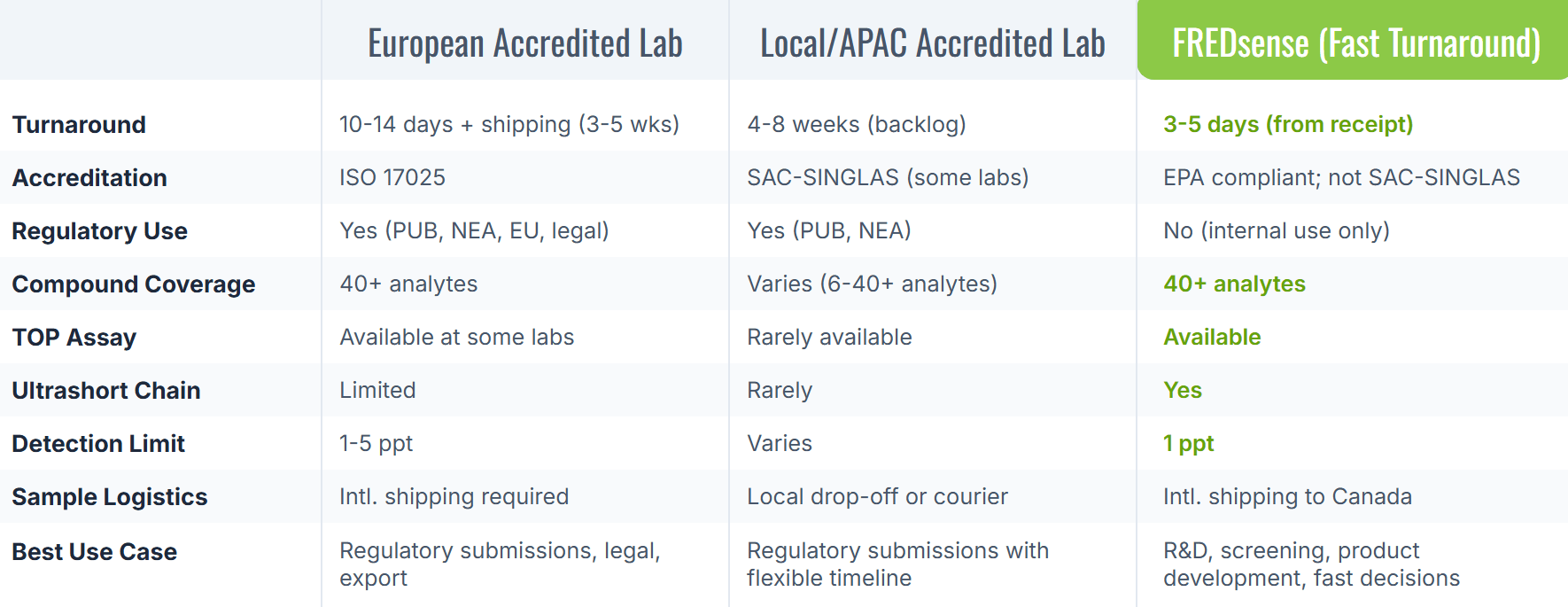
Several well-regarded European laboratories offer PFAS analysis via LC-MS/MS with ISO 17025 accreditation. This is the highest-credibility option available for testing and the correct choice when results are destined for regulatory submissions, legal proceedings, or formal export certification.
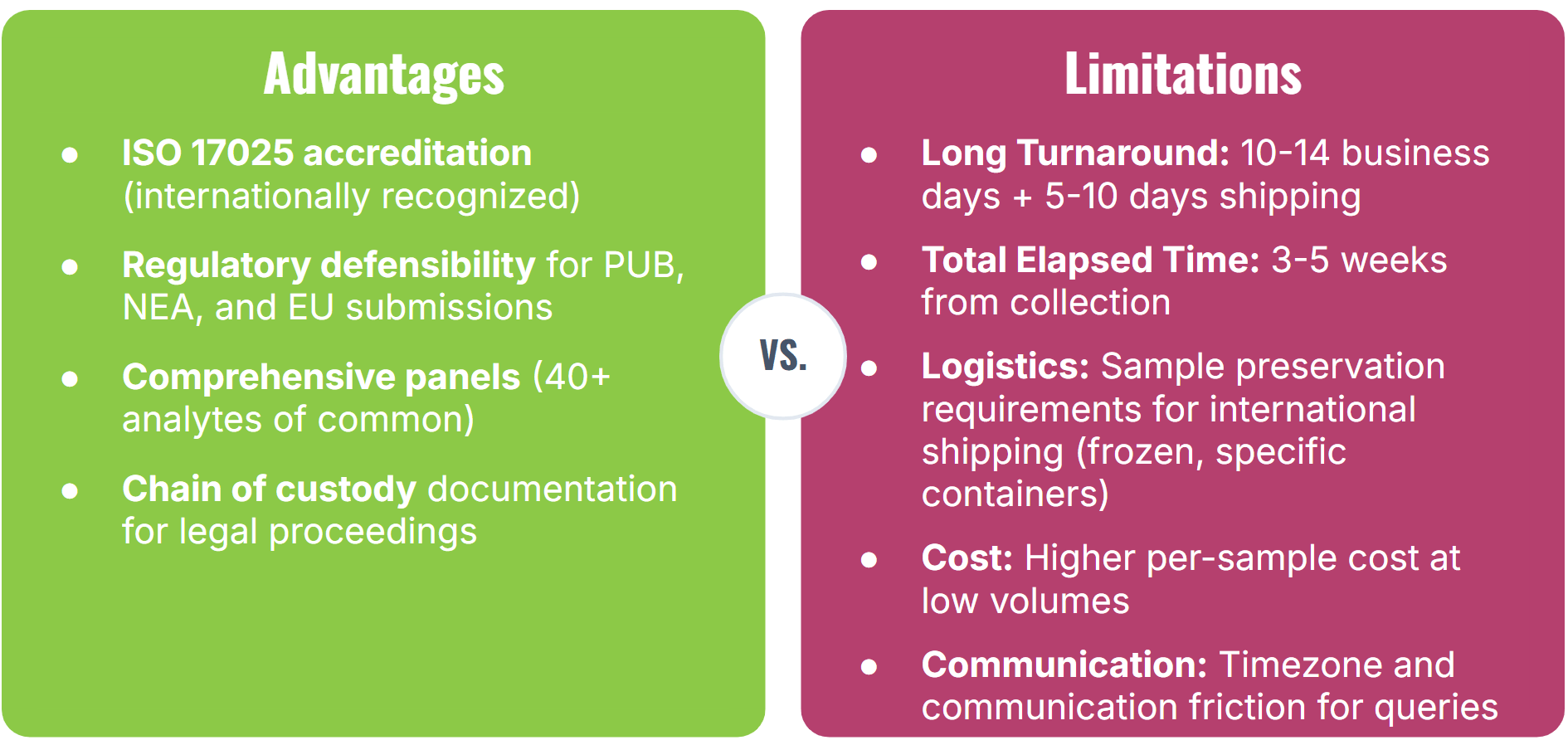
Option 2: Local Singapore and APAC laboratories
Singapore has a small number of laboratories offering PFAS analysis, some of which hold SAC-SINGLAS accreditation (Singapore’s national accreditation body, aligned with ISO 17025). Several APAC-region labs in Malaysia, Australia, and Japan also serve Singapore clients. This is the nearest-to-home accredited option, but current market conditions mean capacity is the dominant constraint.
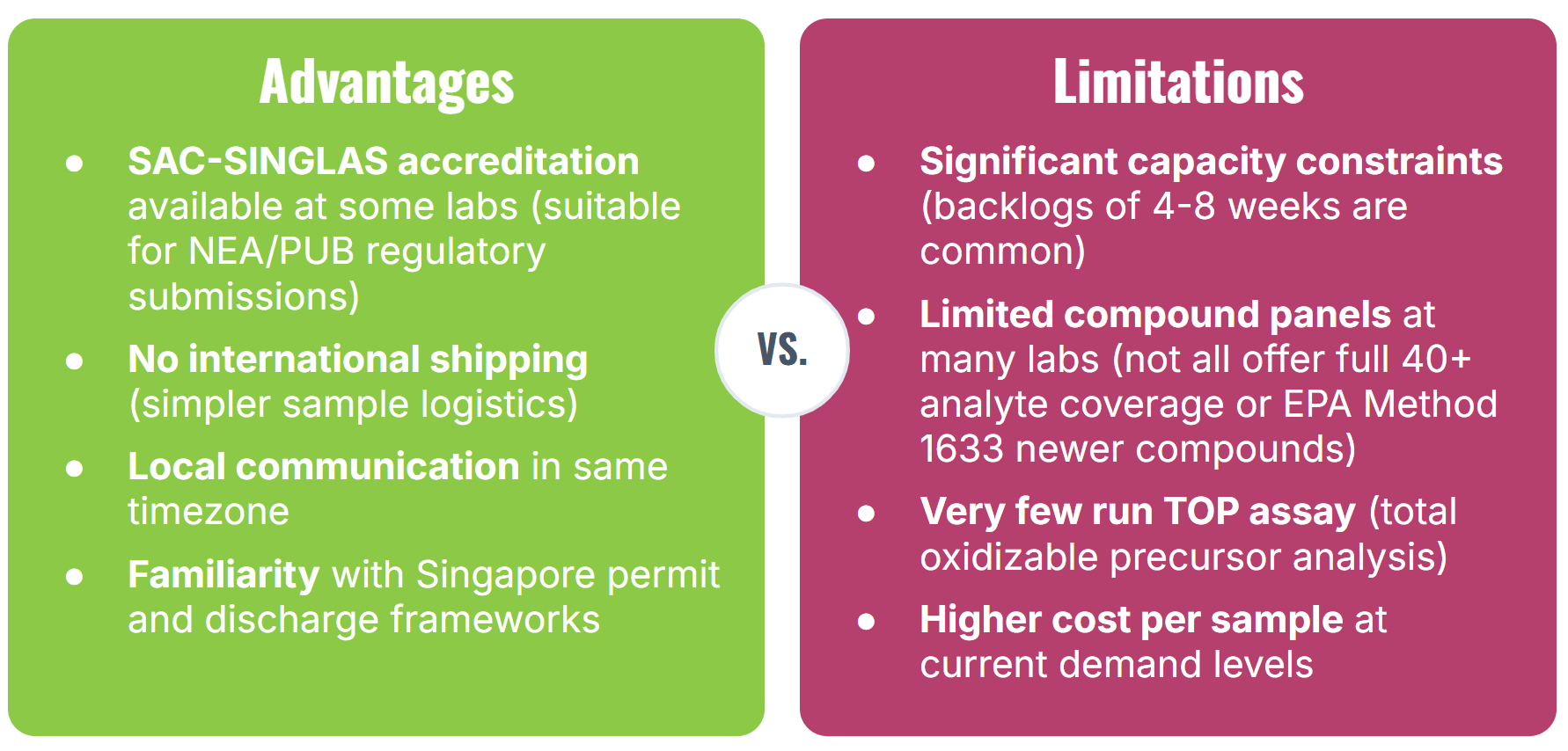
Option 2 is best for: Regulatory compliance submissions to PUB or NEA where you have flexible timelines, and where local accreditation is a stated requirement in your permit or project specification.
Option 3: Fast-turnaround LC-MS lab services
FREDsense Technologies runs LC-MS/MS PFAS analysis from its Canadian laboratory using EPA Methods 537.1 and 1633, with detection limits as low as 1 part-per-trillion. Results are returned within 3-5 business days of sample arrival. The service covers 40+ PFAS analytes and includes ultrashort-chain compound coverage and the Total Oxidizable Precursor (TOP) assay.
The key distinction from Options 1 and 2 is accreditation: FREDsense’s lab is not SAC-SINGLAS accredited. This means results are not suitable for formal regulatory submissions to PUB or NEA in contexts requiring locally accredited data. For all other use cases (R&D, product development, process optimisation, screening, baseline characterisation, and internal decision-making) the method quality, compound coverage, and turnaround time are the relevant criteria.
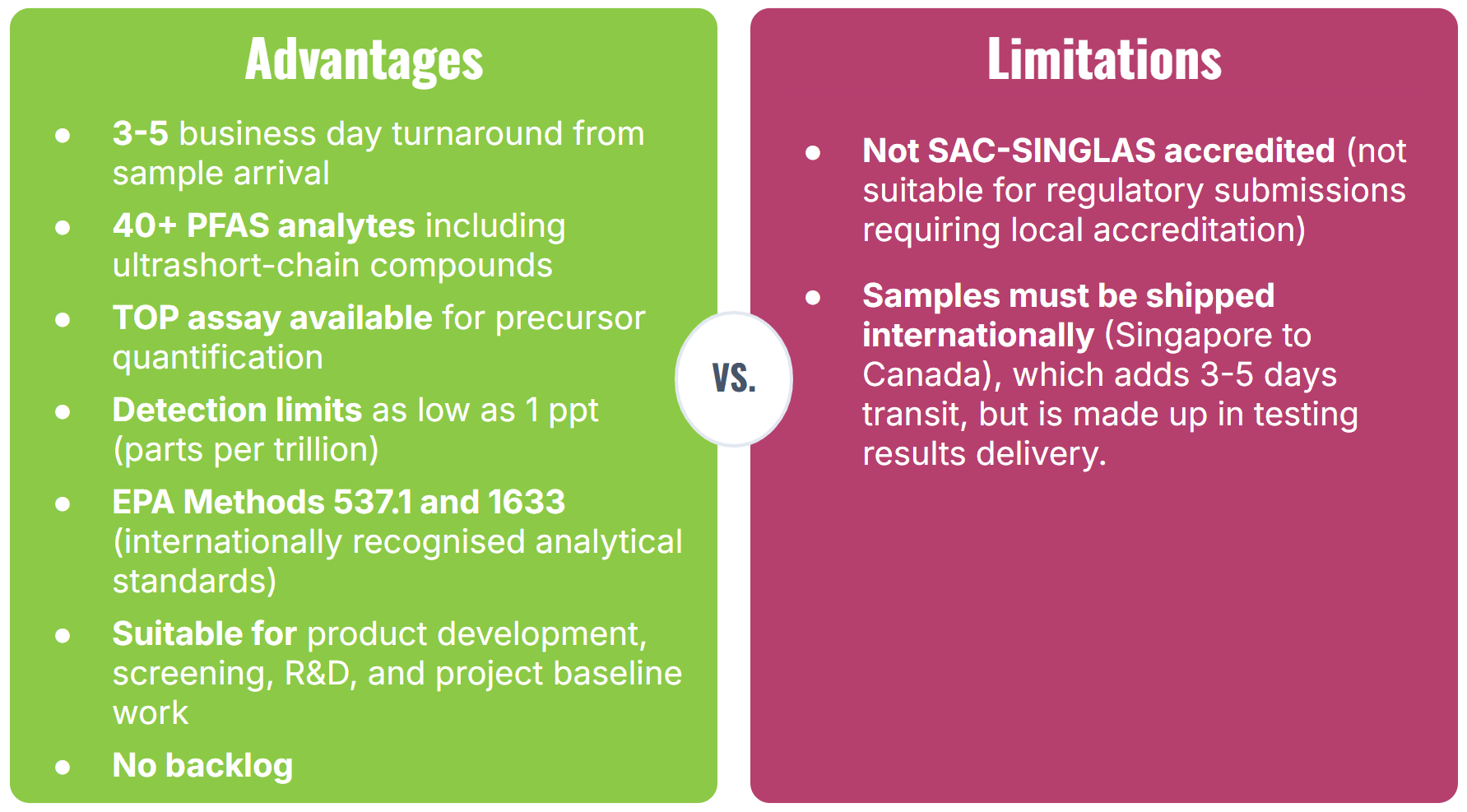
PFAS Lab Service Side-by-side comparison
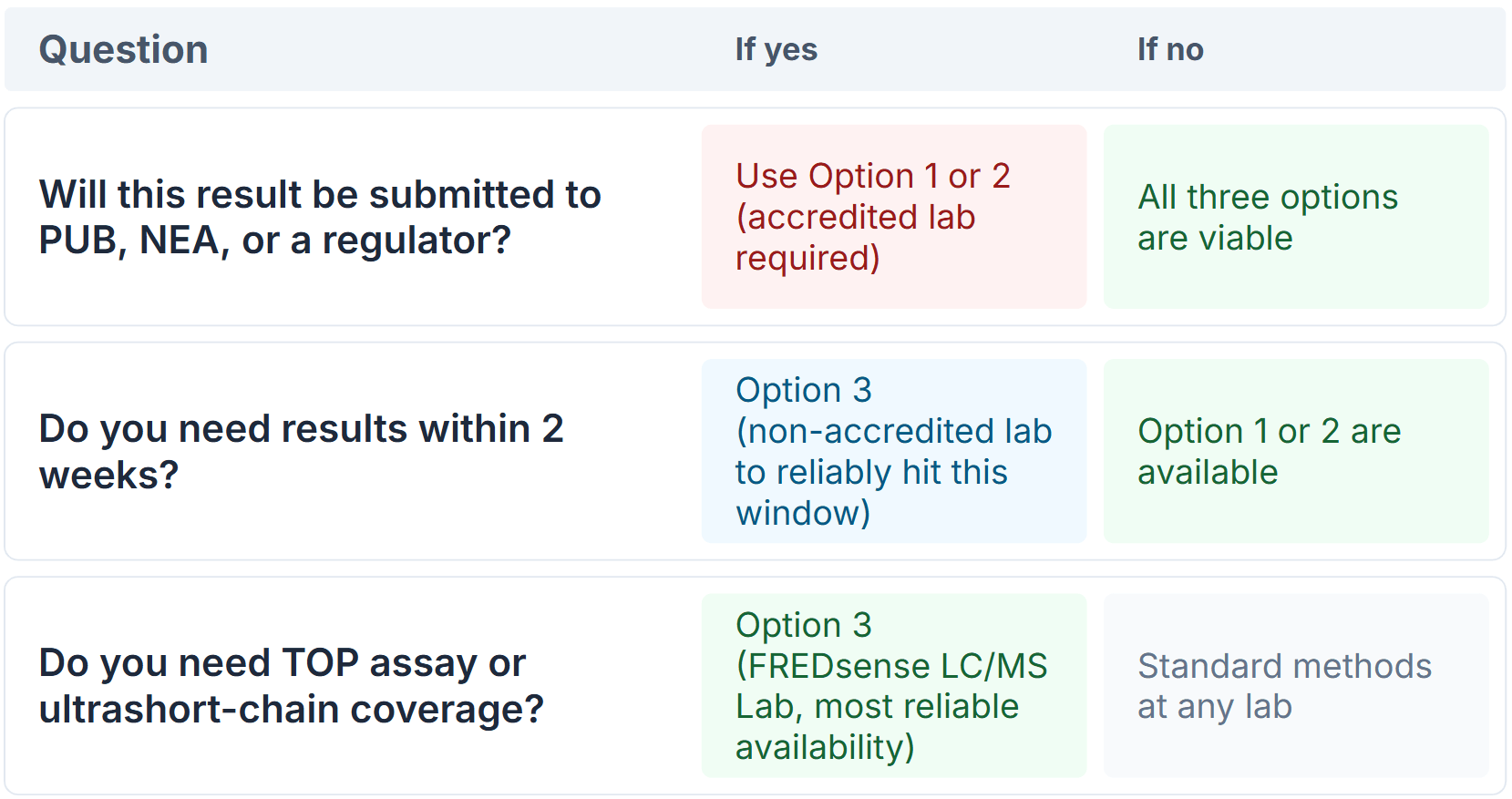
Which PFAS testing option is right for your situation?
Answer these three questions before booking a test:
A practical PFAS testing strategy for Singapore water technology companies
For most membrane manufacturers and solution providers, the answer is not one option. It is a two-track approach:
- Track 1: Use non-accredited labs, like FREDsense, for fast screening, R&D validation, and baseline characterisation. Run samples at speed while your project moves, without waiting 4-8 weeks for a local lab slot.
- Track 2: Use a local accredited lab or European lab for final compliance submissions, permit applications, or client-facing regulatory documentation where accreditation is explicitly required.
This approach gets you the data you need to make project decisions quickly, while keeping the formal compliance pathway intact. Most Singapore water technology companies that have adopted this two-track model report significant reductions in project delays attributable to lab wait times.
About FREDsense Technologies
FREDsense Technologies is a Canadian water technology company providing rapid PFAS lab services via LC-MS/MS analysis. The lab runs EPA Methods 537.1 and 1633, covering 40+ PFAS analytes at detection limits as low as 1 part-per-trillion with a standard 5-business-day turnaround. The service includes ultrashort-chain PFAS coverage and the Total Oxidizable Precursor (TOP) assay.
FREDsense serves environmental consultants, membrane manufacturers, water treatment solution providers, municipal utilities, and industrial clients across North America, Europe, and Asia-Pacific.
Contact FREDsense to discuss your Singapore PFAS testing requirements: sales@fredsense.com | fredsense.com/pfas-lab-services