How to Read Your PFAS Report: A Complete Guide

June 19, 2025

PFAS is a global challenge that requires technical nuance to understand. That nuance can show up in your PFAS report. Knowing what to look for and how to find it in a complex report is key to getting the most out of your PFAS monitoring program. 

At FREDsense, we have created reports for over 7,000 PFAS samples and have read hundreds of third party lab reports. We’ve compiled the lessons we have learned along the way for you. 

In this article you will learn:

  • Key Terms to know before you dig into the report
  • How to read a PFAS lab report
  • What to look for, red flags in your data, and how to take action on your results

Let’s dive in. 

Key Terms and Units Found in a PFAS Report

PFAS reports can be technically dense, filled with acronyms, numeric values in extremely low concentrations, and laboratory-specific terminology. 

A clear understanding of the key terms and units is essential for accurately interpreting data and determining whether further action is required.

Understanding PFAS Acronyms (PFOA, PFOS, etc.)

PFAS acronyms are structured to convey key chemical characteristics of each compound. They can generally be broken down into components:

Numbers in Front: The numbers represent the number of carbons that are fluorinated and non-fluorinated in the compound. 

PFAS Class Type: The first two letters often indicate the broader chemical class (e.g., PF for perfluoroalkyl or polyfluoroalkyl).

Carbon Chain Length: The next letter or abbreviation denotes the length of the fluorinated carbon chain. For example:
– B = Butanoic acid (4 carbon atoms)
– Hx = Hexanoic acid (6 carbon atoms)
– O = Octanoic acid (8 carbon atoms)

Functional Group: The final portion of the acronym identifies the terminal functional group, which defines the compound’s behavior and reactivity:
– A = Carboxylic acid (e.g., PFOA)
– S = Sulfonic acid (e.g., PFOS)

Concentrations (ng/L or ppt)

PFAS concentrations in environmental samples are typically reported in nanograms per liter (ng/L), which is equivalent to parts per trillion (ppt). 

ng/L (ppt)
ug/L (ppb)
mg/L (ppm)
1
0.001
0.000001
1,000
1
0.001
1,000,000
1,000
1

A level comparable to one drop of water in 20 Olympic-sized swimming pools. This extreme sensitivity requires meticulous sample handling and high-resolution analytical instrumentation such as LC-MS/MS.

Reporting Limits vs. Method Detection Limits

These two terms are often confused but have distinct regulatory and analytical implications:

  • Method Detection Limit (MDL): The lowest concentration of a substance that can be reliably detected (but not necessarily quantified) with 99% confidence under ideal conditions.
  • Reporting Limit (RL): The minimum concentration at which quantitative results are considered accurate and defensible. This value is often set higher than the MDL to account for matrix effects, recovery variability, and regulatory thresholds.

💡 Pro Tip: The RL will be more important to you when reading your report. MDLs are often theoretical limits that cannot be reached in real-world scenarios. 

The Structure of a PFAS Report

While each laboratory may use its own formatting, most PFAS analytical reports adhere to a standardized structure to ensure clarity, consistency, and regulatory compliance. Whether the testing is conducted under EPA Method 537.1, 533, or 1633, accredited labs follow established conventions to help consultants, regulators, and decision-makers interpret results correctly.

Understanding the anatomy of a PFAS report allows clients to quickly validate sampling coverage, confirm data quality, and identify exceedances that warrant action. Here’s a breakdown of the core components—and how your PFAS lab can support interpretation at each stage.

Sample Overview

This section provides the contextual metadata for the samples submitted:

  • Client/Project Information
  • Sampling Date and Time
  • Sample Preservation and Holding Time Compliance
  • Chain of Custody (CoC) Reference

These details are critical to tracking which samples are for which parts of your sampling program. Knowing when the samples were analyzed, what project they are from, and how long they took to be analyzed is the first step to understanding your PFAS report. 

đź’ˇPro Tip: If you need accredited laboratory results: 1. Make sure you request an accredited report. 2. Make sure the requested test is within the scope of accreditation. An accredited laboratory does not mean they comply on all tests. 3. Make sure the laboratory address is an accredited location.

PFAS Analysis Results

This is the core of the report: the quantitative data for each PFAS analyte tested. Results are typically displayed in tabular format, with each row representing an individual compound and columns showing:

  • Sample Identification (ID)
  • Matrix Type for Each Sample
  • Analyte Name (e.g., PFOS, PFOA)
  • Result (ng/L or µg/kg)
  • Reporting Limit (RL)
  • Detection Flag

This is where you will spend most of your time to understand what the data is saying and how you can use it. 

🎉The FREDsense Difference: FREDsense lab reports are made with readability in mind. Based on client feedback, we have optimized for comparing results across multiple samples so you can spend your time actioning the data rather than organizing it. 

Quality Control and Comments

This section outlines the laboratory’s QA/QC performance for the analytical batch, providing transparency on the validity and reliability of results. It typically includes:

  • Surrogate Recoveries
  • Method Blank and Laboratory Control Sample (LCS) results
  • Matrix Spike/Matrix Spike Duplicate (MS/MSD) recoveries
  • Field and Trip Blanks

💡Pro Tip: Check out the Remarks section of your report for your labs interpretation of the QA/QC results. 

How to Interpret Your PFAS Results

Interpreting a PFAS report goes beyond simply reading the numerical values. It requires understanding analytical context, regulatory thresholds, and data quality metrics to make accurate, defensible decisions. 

In a regulatory and legal environment where decisions can hinge on differences of just a few parts per trillion (ppt), interpretation must be precise and informed by both chemistry and policy.

Comparing to your Project Objective

Context is very important when it comes to reading your PFAS report. Acceptable results in one case could be non-acceptable through another. When reading your lab report you will want to think of it in context with:

  • Project Specific Data Quality Objectives: What reporting limits, surrogate recoveries, and 
  • PFAS concentrations of Interest: Which PFAS are you interested in and is a total method appropriate?
  • Regulatory Drivers: Understanding what levels are required for your project
  • Related Site Characteristics: Contaminant mobility, hydrogeology, and proximity to drinking water

đź’ˇPro Tip: Involving your lab in your sampling plan makes it easier for you to get the data you need.

Surrogate Recoveries

A surrogate is a compound that is deliberately added to a sample before analysis. It can be the isotopically labeled PFAS analogs or a grouping of compounds.Surrogates are added to each sample to verify the performance of the extraction and analysis process.

Recoveries for PFAS analysis can vary widely from contaminant to contaminant. For Example, here are the EPA 1633 acceptable recoveries: 
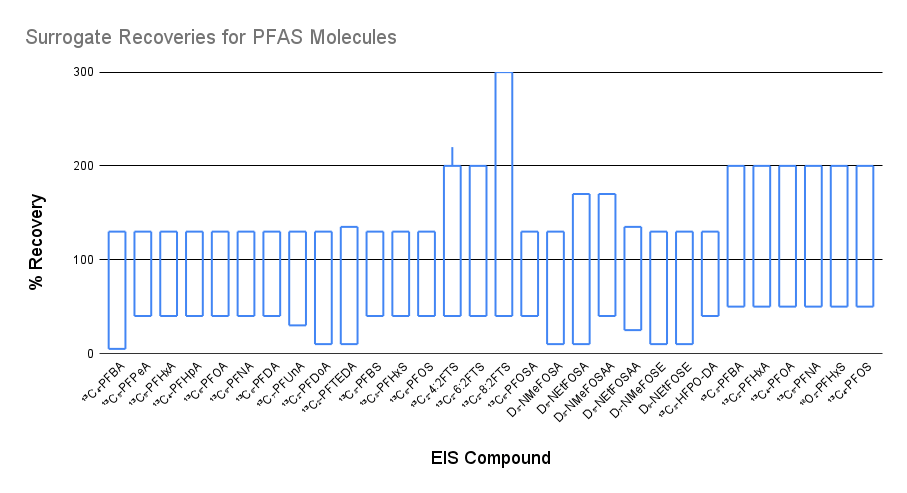
These recoveries can range from 70-130% all the way to 10-300% for different PFAS compounds. Huge swings that can have major implications for your data. 

Labs will often offset these recoveries with a correction factor. When recoveries are very low or very high, this can introduce extra error in your analysis. 

đź’ˇPro Tip: Your lab can clearly flag out-of-range surrogate recoveries, explain implications for data usability, and recommend reanalysis when necessary. For regulatory reports, your lab can include QA/QC summaries that simplify third-party review and reduce client liability. You just need to ask.

Common Mistakes Professionals Make When Reading PFAS Reports

PFAS analytical reports are nuanced and often only partially understood, especially by those unfamiliar with trace-level environmental chemistry or regulatory reporting conventions.

Ignoring Total PFAS vs. Individual Compound Levels

Many PFAS risk assessments focus solely on the presence of regulated “indicator compounds” like PFOA and PFOS. However, PFAS contamination is often the result of complex mixtures, especially in AFFF-impacted or industrial sites.

Focusing only on select analytes while ignoring the total PFAS load (sum of detected compounds) or the presence of precursors (e.g., fluorotelomer sulfonates, diPAPs) can lead to an underestimation of environmental or human health risk.

You can consider Total PFAS analysis methods like TOP Assay, Total Organoflourine, Absorbable Organic Fluorine (EPA 1621), and FRED-PFAS. 

This helps you see the bigger picture,make informed decisions beyond regulatory minimums, and can be an interesting complementary dataset to a regulated compound  dataset.

Learn more about On-site Total PFAS Testing with FRED-PFAS

Overlooking Sample Matrix and Methodology

PFAS behavior varies significantly across different matrices. Groundwater, wastewater, surface water, and soil each present unique interferences, background levels, and recovery challenges.

Likewise, different methods (e.g., EPA 537.1, 533, or 1633) have varying compound scopes, extraction techniques, and sensitivity thresholds. Comparing results from different methods or matrices without accounting for these variables can lead to flawed interpretations or poor trend analysis.

đź’ˇPro Tip: Direct Injection Methods like EPA 8327 offer faster turnaround times and lower costs. However, they introduce higher RLs and significant increases in error. It is often better to find a lab that can turnaround your data in a timely manner than to use a Direct Injection method.

Mistaking Certification for High Quality

While laboratory accreditation (e.g., NELAC, CALA) ensures that a lab has demonstrated competency, it does not guarantee high-quality data on a project-specific basis. 

Key indicators of high data quality are often overlooked by clients who rely solely on accreditation status. Pay attention to appropriate surrogate recovery, accurate blank subtraction, and transparent QC reporting,

Even sophisticated users can misinterpret PFAS reports when nuance is lost in the complexity of ultra-trace analysis. So make sure you know when you should be “raising your red flag”

đź’ˇPro Tip: A common example is when a matrix has ultra trace analytes mixed with high concentrations of other PFAS analytes. This can have a significant impact on your RLs. An inexperienced user will read their lower level PFAS as non detect without noticing the corresponding RL increase.

When to Raise the Red Flag on Your PFAS Results

Not all PFAS data is created equal. While detection of a regulated compound may prompt immediate concern, data quality issues often fly under the radar. 

Even small deviations in analytical performance can render data scientifically or legally unreliable, which can impact everything from risk assessments to regulatory compliance and litigation.

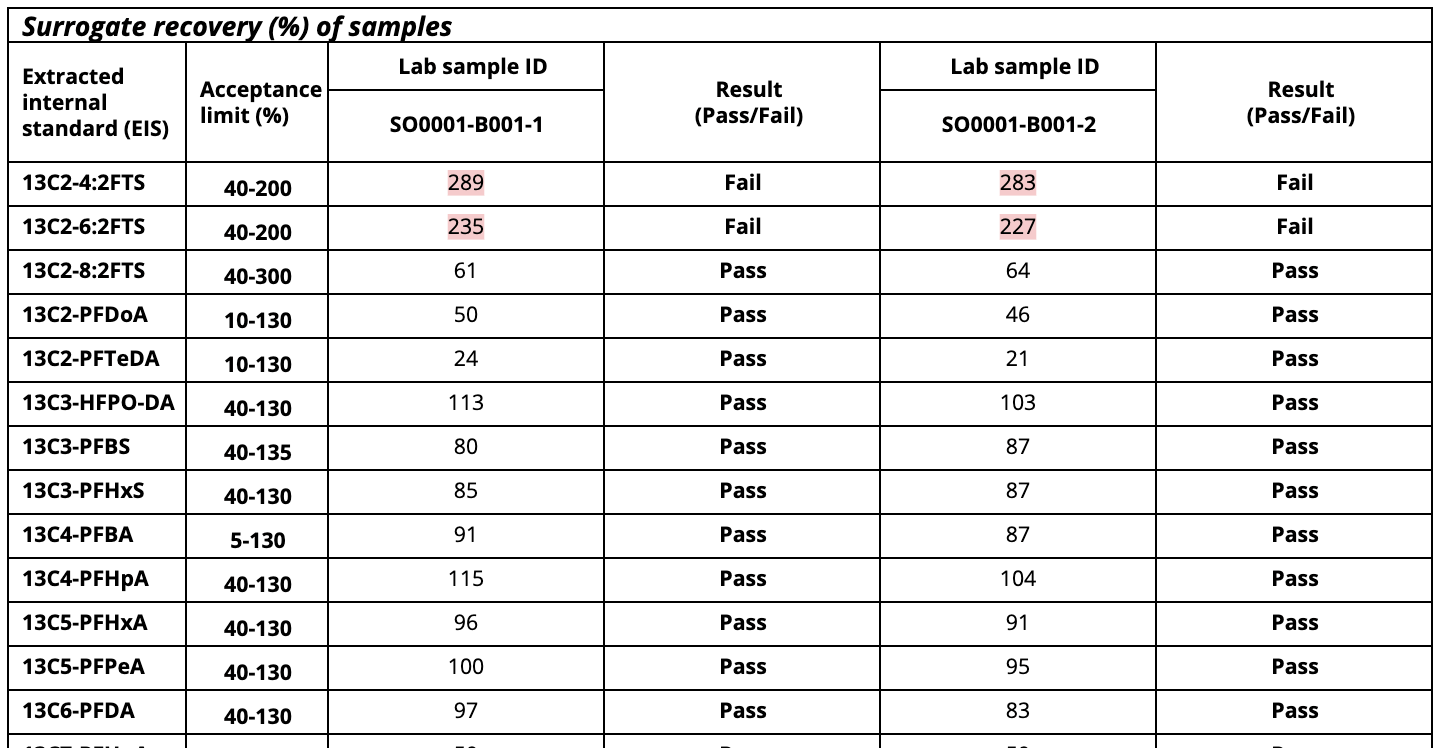
Poor Surrogate Recovery

🚩Red Flag Criteria:

  • Recoveries outside the method-defined range (commonly 70–130%) may indicate matrix interference or procedural failure.
  • Non-reported surrogate values signal a reporting omission or QC failure.
  • Consistently low recoveries across samples suggest systemic analytical issues, not isolated variability.

💡Pro Tip: Poor surrogate recovery can undermine the validity of the associated PFAS concentrations, especially for compounds reported as “non-detect.”
High Blank Values

Blanks (method, lab, field, trip) are essential controls to confirm that contamination has not been introduced during sample handling, preparation, or analysis. Due to PFAS’s extreme ubiquity and low detection thresholds, even minor contamination can distort results.

🚩Red Flag Criteria:

  • Analytes detected in blanks above the laboratory’s acceptance limits (typically RL or one-half RL).
  • Detected levels in blanks that are ≥10% of the sample concentration.
  • Consistent blank contamination across batches suggests laboratory or field procedural issues (e.g., Teflon contamination, cross-contamination).

High blank values raise the risk of false positives, particularly when sample detections are low-level and close to the RL.

Poor Spike Recoveries or High Relative Percent Difference (RPD)

Matrix spikes and duplicates assess the accuracy and precision of PFAS quantification in real-world sample matrices, especially those known to cause suppression or interference (e.g., landfill leachate, industrial wastewater).

🚩Red Flag Criteria:

  • Spike Recoveries outside the acceptable range (typically 70–130%, though method-dependent).
  • Relative Percent Difference (RPD) between matrix spike and duplicate samples exceeding method limits (e.g., >30% RPD).

Inability to quantify spikes due to matrix interference, signal suppression, or co-eluting compounds.

These issues may suggest that the method is not adequately controlling for matrix complexity, resulting in non-representative concentrations or unreliable non-detects.

FAQs

How do I pick a PFAS lab for my situation? 

PFAS labs come in multiple shapes and sizes. Picking a lab can depend heavily on your project needs. 

  • Small labs are nimble and provide faster turnaround time
  • Non-certified labs provide the same level of data quality with readable formats
  • Large, certified labs provide the regulatory stamp of approval

Do my PFAS results need to be certified? 

Often times PFAS results do not need to be certified. Regulations are currently being drawn so certification in some locations is still developing. 

Even so, process optimization and internal use PFAS results do not need certification because they are not going to a regulator. Knowing the difference can save you a fortune in time and money. 

Is there a faster way to get PFAS results than waiting weeks for lab results? 

FREDsense offers 2 solutions to this problem. 5-Day turnaround lab services and an on-site screening kit to get data in your hands within 4 hours. Reach out today to find out more.Â